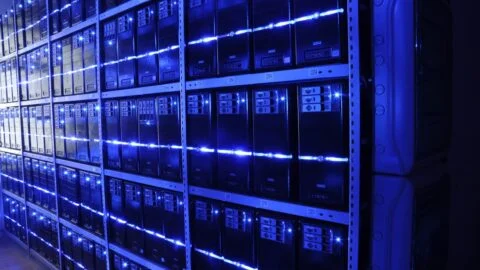

The most technically significant agreement at the Montreal summit may also be the least political: access to computing power. The EU and Canada are set to finalise an arrangement on Friday allowing Canadian companies, startups and researchers to access a European network of 12 supercomputers, a step that gives Canadian AI researchers and firms capacity they could not build quickly on their own. For a technology sector that is constrained less by ideas than by compute, that access is a practical advantage, not a symbolic one.
Supercomputers matter because frontier AI models require infrastructure at a scale that few organisations can provide alone. Training a large model can take thousands of specialised processors running for weeks, and the cost of that compute is a barrier to entry for startups and university researchers. Access to a shared European network lowers that barrier, allowing smaller Canadian firms to test ideas that would otherwise require capital they do not have. The arrangement also fits the summit’s wider digital agenda, which includes a digital trade deal, closer cooperation on licensing and supervision, and youth mobility for researchers and students.
Who benefits, and how quickly
The benefit depends on the details, and the details are not yet public. Allocation rules, pricing, data governance and application speed will determine whether the network serves startups or only established institutions, whether Canadian firms can access it quickly or must wait in a queue behind European users, and whether the data processed on European machines is governed by Canadian or European rules. Those questions are technical, but they are also political, because they determine who actually gains from the agreement.
Canada’s parallel investment, 1.6 billion Canadian dollars in the Toronto AI firm Cohere, shows that Ottawa is not relying on access alone. A domestic champion gives Canada a company that can turn research into products, while European access gives researchers the machines to do the research in the first place. The pairing suggests a strategy that is both outward looking and domestic: use foreign infrastructure where it helps, and build domestic capacity where it matters.
The wider digital relationship
The supercomputer agreement sits within a broader digital relationship that includes participation in the Galileo satellite system, cooperation on digital trade, and the Erasmus youth exchange. Each element is modest on its own, but together they describe a Canada EU digital space that is less dependent on American infrastructure, a goal that both sides have pursued since the current American administration questioned the value of traditional alliances. The reporting on the summit’s wider partnership ambitions shows how the digital agenda fits into a larger strategic shift.
For Canadian technology firms, the test will be practical: can they apply, can they get time on the machines, and can they afford it. If the answer to all three is yes, Montreal will have delivered something more valuable than a slogan. It will have delivered compute, and compute, in the AI era, is the closest thing to a raw material that the technology industry has.